
Maintain Your System: A How-To Guide
The sales pitch for solar energy in the Philippines often relies on the phrase "maintenance-free." While it is true that solar PV systems have no moving parts and are incredibly durable compared to a diesel generator, "maintenance-free" is a myth. A more accurate description is "low maintenance."
If you have invested anywhere from ₱200,000 to over ₱1 million on a rooftop system, neglecting it is a financial risk. A dirty, shaded, or loosely connected system will not produce the yield calculated in your initial Return on Investment (ROI) study. In the Philippine context—where we deal with extreme heat, heavy monsoon rains, salt spray, and typhoons—passive neglect can lead to equipment failure or voided warranties.
This guide covers the practical steps to maintain your grid-tied or hybrid solar system, ensuring it continues to offset your Meralco or cooperative bill effectively for the next 25 years.
The Philippine Environment and Your Panels
To understand maintenance, you have to understand what your system is fighting against. The Philippines presents a unique set of environmental stressors for solar hardware.
Dust and Soiling: During the dry season (typically March to May), dust accumulation is significant. In urban areas like Metro Manila, this is compounded by smog and vehicular exhaust, which creates a sticky film on the glass. In agricultural provinces, dust from rice milling or unpaved roads can cover panels quickly.
Bird Droppings: If your roof is near trees or power lines, bird droppings are inevitable. Unlike dust, rain does not easily wash these away. They create "hard shading," which can cause hotspots—localized overheating that permanently damages the solar cells.
Salt Mist: For installations in coastal areas (which is a large portion of the archipelago), salt corrosion is a silent killer. It attacks aluminum frames and, more dangerously, the electrical connectors (MC4) if they are not properly crimped or shielded.
Thermal Cycling: Philippine roofs get incredibly hot, often exceeding 70°C. At night, they cool down. This constant expansion and contraction can loosen bolts and electrical terminations over time.
Routine Cleaning: The DIY Approach
The most common maintenance task is cleaning. Dirty panels produce less electricity. Studies have shown that heavy soiling in the Philippines can reduce output by 15% to 25%.
When to Clean
You do not need to clean your panels every week. In the rainy season, nature does the work for you. However, during the dry months, you should check your system’s performance. If you notice a drop in daily generation without a change in weather, it is time to wash them. For a deeper dive into scheduling, you can read our specific analysis on solar cleaning frequency in the Philippines.
The Equipment
You do not need expensive specialized equipment for a residential setup. You need:
Water source: A garden hose is usually sufficient.
Soft brush/sponge: Use a non-abrasive sponge or a soft-bristled brush on an extendable pole. Never use steel wool or harsh scrubbers.
Squeegee: To remove excess water and prevent calcium spots (if you have hard water).
Safety Gear: If you are climbing the roof, a harness is non-negotiable. If you cannot do it safely, hire a professional.
The Process
Shutdown: While not strictly required for cleaning, it is good practice to shut down the AC isolator and DC isolator (inverter switch) before working near the array for safety.
Rinse: Spray the panels with water to remove loose dust.
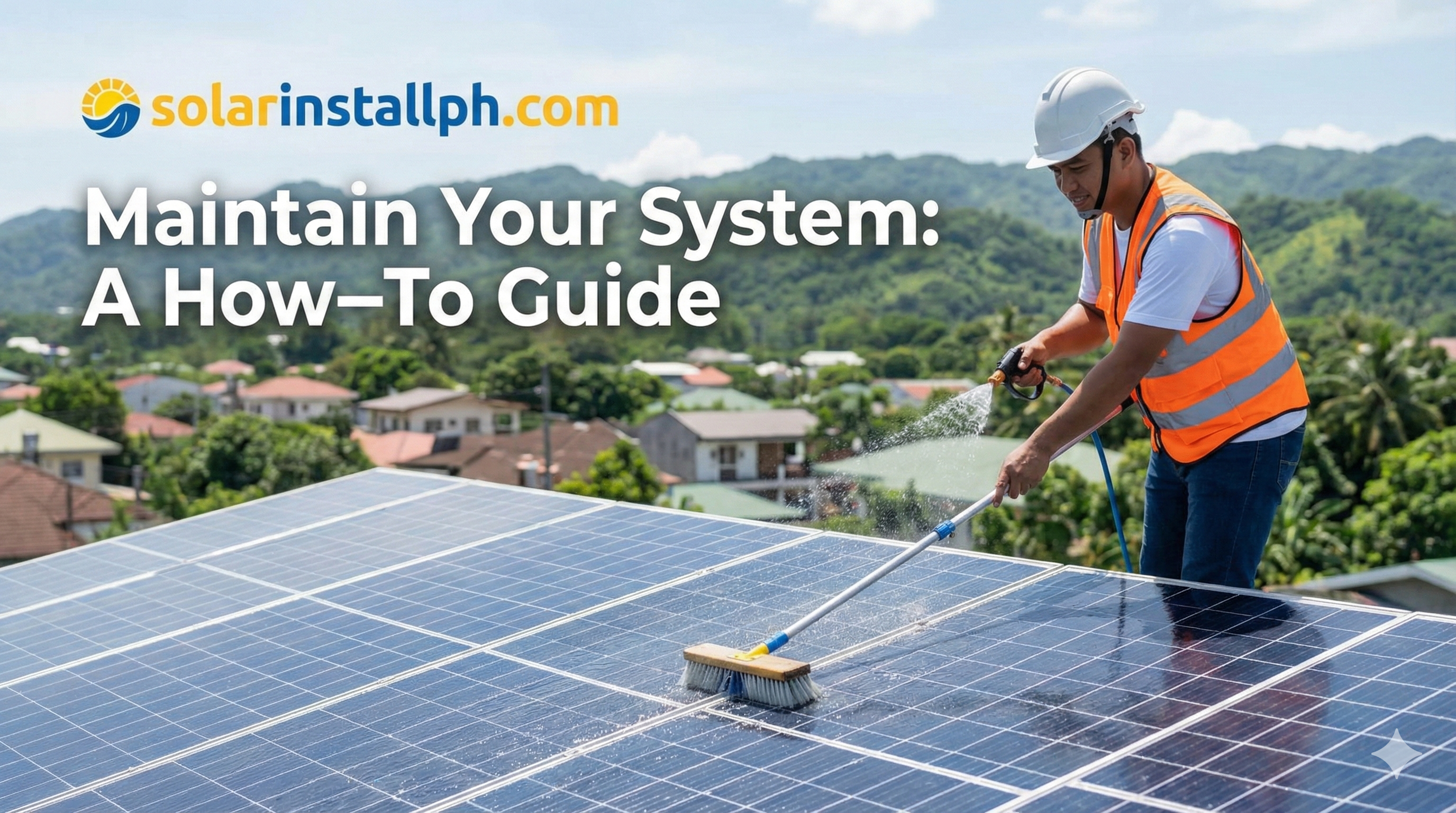
Scrub: Gently scrub wet panels to remove stuck pollen or bird droppings. You usually do not need soap. If you must use soap, use a mild, biodegradable dish soap. Harsh chemicals can damage the anti-reflective coating on the glass.
Rinse Again: Ensure no soap residue is left.
Critical Warning: Thermal Shock
Never clean your solar panels during the heat of the day (10:00 AM to 3:00 PM). Spraying cold tap water onto hot glass that has been baking in the Philippine sun can cause "thermal shock," shattering the glass instantly. The best time to clean is early morning (6:00 AM - 7:00 AM) or late afternoon.
Monitoring: The Digital Health Check
Your inverter is the brain of the operation, and it is also your primary diagnostic tool. Most modern installations in the Philippines—using brands like Huawei, Growatt, Solis, or Deye—come with Wi-Fi monitoring.
Daily/Weekly Checks
You should have an app on your phone. Make it a habit to check it once a week. You aren't looking for technical engineering data; you are looking for anomalies.
Zero Production: If the sun is out but the graph is flat, a breaker might have tripped, or the grid might be down (for grid-tied systems without backup).
Low Voltage: If one string of panels is showing significantly lower voltage than another similar string, you might have a connection issue or a failed panel.
Error Codes: Inverters will display specific alphanumeric codes when something is wrong. Don't ignore red lights on the inverter box. If you see a fault, cross-reference it with our guide on common inverter error codes to understand if it's a simple grid fluctuation or a hardware failure.
Physical Inverter Inspection
Go to where the inverter is mounted. Listen to it. A quiet hum is normal. Loud grinding noises from the cooling fans are not—fans are the only moving part in many inverters and are a common failure point after 5-7 years. Ensure the heat sink (the metal fins on the back) is free of cobwebs, lizards, or nests, as this blocks airflow and causes the unit to overheat and derate (reduce power) to protect itself.
Comprehensive Physical Inspections
While cleaning deals with the glass, the structural and electrical integrity of the system requires a closer look. You should perform a visual inspection (from the ground or safely on the roof) at least twice a year.
The Mounting Structure
The aluminum rails and stainless steel bolts holding your panels are under constant stress from wind.
Check for loose clamps: Look for mid-clamps (between panels) or end-clamps that look crooked or lifted. A loose clamp means a panel could fly off during a typhoon.
Roof penetration: Check the area where the L-feet or mounting hooks attach to your roof. If you see rust streaks or water marks in your ceiling below the array, the sealant has failed. This needs immediate waterproofing.
Wiring and Conduits
Solar cables (PV wire) are UV rated, but they are not invincible.
Cable Management: Cables should be clipped neatly to the rails, not resting on the roof surface. If cables touch the roof, water damming and friction can wear through the insulation, leading to dangerous DC arc faults.
Conduit Condition: In the Philippines, we often use PVC conduit for external runs. Over time, UV radiation makes PVC brittle. Check for cracks or broken fittings that could let water into your combiner box or inverter.
For a full checklist of what to look for during a walk-around, refer to our article on solar panel maintenance.
Typhoon Preparedness and Post-Storm Checks
We cannot discuss maintenance in the Philippines without addressing typhoons. Your system is designed to withstand wind loads (usually up to 200kph or more if engineered correctly), but maintenance plays a huge role in survival.
Pre-Typhoon
If a signal is raised:
Clear debris: Remove loose branches or coconuts from nearby trees that could impact the panels.
Check security: If you have safe access, ensure no panels are visibly loose.
Do not cover them: Some homeowners try to put tarps over panels. This is dangerous and unnecessary. It creates a sail effect that can rip the structure off the roof.
Post-Typhoon
After the storm passes, do not immediately switch everything back on if the grid returns.
Visual Check: Look for flying debris impact cracks. Microcracks are hard to see, but shattered glass is obvious.
Check Wiring: Strong winds can rip loose cables out of their management clips. Ensure no wires are hanging loose or stripped.
Inverter Check: Ensure the inverter remained dry. If the area flooded or if rain was driven horizontally into the inverter area, wait for it to dry completely before energizing.
For detailed information on how mounting systems are designed to handle these storms, read about solar typhoon resistance.
The Role of Professional Servicing
While DIY cleaning and visual checks are excellent, you should budget for a professional "preventative maintenance schedule" (PMS) every 2 to 3 years. A qualified solar technician does things you cannot do safely.
What Pros Do:
Torque Check: They use a torque wrench to tighten every bolt to the manufacturer's specification.
Electrical Testing: They perform insulation resistance testing (Megger test) to ensure the wiring insulation hasn't degraded.
Thermal Imaging: They use infrared cameras to scan the panels while they are operating. This detects hotspots—cells that are overheating due to internal defects or soldering failures—that are invisible to the naked eye.
String Testing: Checking the Voc (Voltage Open Circuit) and Isc (Current Short Circuit) to ensure the strings are healthy.
Hiring a professional also creates a paper trail of maintenance. This is crucial for warranty claims. If a panel fails in Year 8, the manufacturer may ask for proof that the system was not neglected. Understanding solar warranties and their requirements can save you a headache later.
Safety First: Electrical Hazards
A grid-tied solar system involves high-voltage DC electricity (often 300V to 800V).
DC is Dangerous: Unlike AC, DC power is constant and difficult to break. It can arc across gaps. Never unplug a solar connector (MC4) while the system is under load (generating power). It will pull an arc that can melt the plastic and cause a fire.
Grounding: Ensure the grounding wire (green/yellow) connected to the rail and inverter is intact. This is your primary safety mechanism against lightning surges and electrical faults.
Summary Checklist for Owners
To keep it simple, print this out and keep it with your solar documentation:
Monthly:
Check inverter app for energy production.
Look for error codes.
Quarterly (or as needed):
Wash panels (morning/evening only) if dust is visible.
Remove bird droppings immediately.
Annually:
Visual inspection of roof mounting and cabling.
Check inverter fans and heat sink for blockages.
Trim nearby trees to prevent new shading.
Every 2-3 Years:
Professional electrical inspection and torque check.
Conclusion
Maintaining a solar system in the Philippines is not about being a technician; it is about being an observant owner. The sun provides free energy, but the equipment that harvests it requires respect.
By keeping your panels clean, your inverter cool, and your connections tight, you ensure that your investment pays off as calculated. Neglect leads to extended payback periods and potential safety hazards. Treat your solar power plant like you treat your car: change the oil (clean the panels), check the engine (monitor the app), and take it to the shop (professional PMS) occasionally.
If you are unsure if your system is performing as it should, or if you inherited a house with solar and don't know its history, start with a simple visual check. Your next electric bill will thank you.
